Author: Contributor

  • All set for the 2025 Old Mutual Pension Trustees conference

    All set for the 2025 Old Mutual Pension Trustees conference

    All roads lead to Mangochi next month as preparations reach their peak for the 2025 Old Mutual Pension Trustees Conference, scheduled for 6th to 8th November 2025 at Sunbird Nkopola Lodge.

    The high-level gathering, themed “Shaping the Future of Pensions: Resilience, Sustainability, and Innovation,” is set to attract some of the most influential voices in the region’s financial services and pension sectors.

    Organized under the guidance of the Registrar of Financial Institutions, the summit will convene pension trustees, fund managers, policy experts, and regulators to deliberate on the evolving pension landscape and the future of social protection in Malawi.

    Speaking ahead of the summit, Tawonga Manda, General Manager of Old Mutual Pension Services, said the theme strongly resonates with current national and global economic realities.

    “We are in an era that demands forward-thinking and sustainable pension systems. The summit will focus on how we can make Malawi’s pension sector more resilient, innovative, and responsive to the needs of both current and future retirees,” he said.

    Key topics to be discussed include regulatory reforms, sustainable investments, governance, and crisis resilience.

    The Director of Pension and Insurance Supervision at the Reserve Bank of Malawi, Kaluso Chihana, will open discussions with a session on “Landscaping for Future Reforms,” highlighting how stakeholders can prepare for and influence upcoming changes in the regulatory and policy framework.

    A highly anticipated panel on “Are Guarantees Important for Contributory Pension Funds?” will feature distinguished experts including Mark Mikwamba, Lorraine Mlenga, Stephen Walker (South Africa), Stain Singo, and Prosper Matiashe (Zimbabwe) — promising an engaging debate on the real value and cost of guarantees in pension fund design.

    In line with global sustainability priorities, Mphatso Kasalika will lead a session on “Sustainable and Impactful Investing,” exploring how pension funds can align investments with environmental, social, and governance (ESG) principles, as emphasized in the Pensions Act of 2023.

    Other notable sessions include:

    “Succession Planning and Governance” by Pempho Likongwe

    “Crisis Management and Resilience” by Busani Ngwenya (Zimbabwe)

    “Trends and Innovations in Pension Fund Governance” by Dr. Wisely Phiri (Malawi) — examining how technology and innovation are transforming pension fund management across Africa.

    Set against the serene backdrop of Lake Malawi, the summit promises a perfect blend of knowledge sharing, strategic dialogue, and networking opportunities.

    For many players in the pensions and financial services industry, the event is being hailed as the must-attend conference of the year — a platform to reflect, learn, and shape the direction of Malawi’s pension future.

    As Malawi continues its journey toward greater financial inclusion and retirement security for all, this summit serves as a powerful reminder that the future of pensions depends on the vision, collaboration, and innovation we embrace today.

    Old Mutual remains committed to championing financial inclusion and securing the future of every Malawian. Through platforms such as the National Pension Summit, we reaffirm our role as a trusted partner in building resilient and sustainable pension systems — fully aligned with the aspirations of the Malawi 2063 Agenda.


  • Select Financial Services urges collaboration to boost financial inclusion

    Select Financial Services urges collaboration to boost financial inclusion

    Select Financial Services, one of Malawi’s lending institutions, has called for stronger collaboration between the government and the microfinance sector to sustain financial inclusion amid Malawi’s current economic challenges.

    Founded in 2007, Select Financial Services provides credit and financial solutions to both public and private sector employees.

    The company’s Chief Executive Officer (CEO), Akuzike Kafwamba said that despite inflationary pressures and currency fluctuations, the microfinance sector continues to play a vital role in helping Malawians build financial resilience, hence the need for collaboration.

    “We have seen how access to affordable financial services can transform lives. Our focus remains on providing practical solutions that help individuals and businesses stay afloat, even in difficult economic times,” said Kafwamba.

    Kafwamba said the institution’s 17 years of experience have deepened its understanding of Malawi’s financial realities, enabling it to serve clients often excluded by traditional banking systems.

    “Our goal is not only to lend money but to empower people with financial knowledge and tools that promote stability and growth,” said Kafwamba.

    He urged policy makers to establish frameworks that support innovation, reduce barriers to access, and promote collaboration between regulators and financial service providers.

    “If we work together, government, private sector, and communities, we can build a more inclusive financial system that works for every Malawian,” added Kafwamba.

    A finance expert and senior lecturer in accounting and finance at Millennium University, Richard Tembo commenting on the matter, stressed Select Finance Services’ call on the importance of collaboration between the government and microfinance institutions.

    “The government provides policy direction and ensures financial stability, while microfinance institutions turn those policies into real financial access for people. Working together ensures support mechanisms like consumer protection, financial literacy programs, and responsible lending standards are well aligned.”

    “During economic turbulence, timely access to small loans allows households to manage shocks, maintain consumption, and invest in small ventures. That’s where institutions like Select come in handy,” said Tembo.

    Select Financial Services operates in all the four regions in Malawi and is part of the broader Select Africa Group, which offers microfinance products in multiple African countries including Lesotho, Eswatini, Kenya, Uganda, and Namibia.

  • Where the Blantyre Derby was won and lost 

    Where the Blantyre Derby was won and lost 

    By Raymond Siyaya Jnr:

    FCB Nyasa Big Bullets and their fervent fans had a rude awakening and a derby to forget when they were thumped by three goals to nil by their archrivals Mighty Wanderers in a high stakes football match at the legendary Kamuzu stadium in Blantyre.

    The win means Wanderers are within a single point, but they have a game in hand. If Wanderers win against Songwe Border FC on Wednesday, Bullets could be staring down the barrel of the league slipping through their fingers as Wanderers will leapfrog them and be two points clear.

    Wanderers finally have broken a 10 year double jinx over Bullets, having beaten them one nil in the first round. But were bullets on a time ticking bomb or was this disaster just waiting to happen?

    How did Wanderers pull off this scoreline, and where did Bullets goof?

    FAULTY TACTICAL PHILOSOPHY.

    Peter Mponda, coach for Bullets, admitted in post-match interview that his counterpart Bob Mpinganjira had his tactics spot on and that his players executed instructions excellently.

    For a start, Mponda was too cautious as he broke the norm when he picked four defenders in a 4-1-2-3 tactical formation while Mpinganjira showed intentions of front foot football with a 3-2-3-2 system.

    Clearly, from the outset, Wanderers had an extra player at the midfield as they created an overload around this area with a  5v.3 at the midfield. This allowed Wanderers to dominate,control pace, and momentum, allowing them to make rotations while easily scaling the ball up the pitch.

    Bullets defencive frailities have for long been covered if Bullets control possession,but with a team quick on transitions and aggressive like Wanderers,Bullets defence was exposed and could not cope leading to numerous defensive errors that Andrew Jovinala, Aaron Chilipa and goalkeeper Innocent Nyasulu continously made.

    In addition, Wanderers were relentless in putting pressure on the ball when they lost possession and quickly tracked back, keeping their shape in an organised manner.

    Every Bullets runner was tracked and covered. Hence, Bullets continued to find a Cul-de-sac and repeatedly sent the ball back or played useless square balls.

    Furthermore,Bob Mpinganjira innovated a genius tactical masterclass when he allowed Isaac Kaliati to play narrow, time, and  again to increase numbers in order to swarm the midfield. Muhamad Sulumba, too, was excellently dropping deep to pick up loose balls,linking up with Rajab Nyirenda or Daniel Kudonto and moving the ball to the final third.

    Conversely,Bullets’ wingers of Hassan Kajoke and Salima were too wide, leaving the midfield vulnerable and at a numerical disadvantage. Salima and Kajoke could also not track back effectively to help their fullbacks.

    Felix Zulu, too,  deserves a special mention as he was box to box interms of protecting his defence and adding numbers upfront whenever Wanderers broke free. No wonder he was named man of the match again.

    Peter Mponda saw the vulnerability and pulled out Paul Master and Hassan Kajoke for Mike Mkwate and Wongani Lungu, 35 minutes in the first half to stabilise and add numbers, but Wanderers were already on the pedestal they could not be dislodged from.

    Bob Mpinganjira even made the situation more complex for Bullets when he removed Muhamad Sulumba,who could have buried Bullets with the two glaring goal scoring opportunities he missed for Blessings Singini.

    This time,  Singini paired with Rajab Nyirenda closed down all channels for Bullets to manoeuvre, and Mkwate and Lungu were left chasing their own shadows. Singini brought the drive and the carriage of the ball upfront,  which Wanderers craved, and no wonder he scored two goals.

    BULLETS DEFENCE EXPOSED.

    So much had been said about Bullets’ defence not properly tested by a well structured and organised team that is on the front foot,aggressive, and pressing from the front.

    Bullets defence of Blessings Mpokera, Andrew Jovinala, Aaron Chilipa and Khumbo Banda had nothing to cope with the relentless pressure by Sulumba, Mwalilino and Adam Wallace hence the continuous and repeated miscommunication with goalkeeper, innocent Nyasulu and misplacing passes at the back which allowed Sulumba to pick those loose balls only for him to fluff his lines. It could have been 3 nil by half time.

    These defensive frailities stem from the chopping and changing of defence personnel by Peter Mponda. Because of this inconsistency, players at the back are yet to build synergy, chemistry, relationships, and even partnerships with their goalkeeper. If defenders play together with goalkeeper over time,they are able to read movements interms of where and when to give back the ball to the keeper or even how to build from the back. It is always well coordinated.

    Again, Aaron Chilipa should never have started the game following his previous performance against Mafco, and he showed again that he is unstable, punching above his weight and out of his depth.

    The goal that Adam Wallace scored barely after his introduction in the first half could have been prevented if Chilipa was on the pitch to cover that blindside, but he was out of the pitch being attended to by his team doctor after attempting a botched tackle.

    Unlike Khumbo Banda, Chilipa, at no time did he overlap or underlap to create an overload with kajoke and overwhelm Timothy Silwimba, the Wanderers defender.  Chilipa looked like a full back who was pinned in defence and could not move up the pitch.

    This is unlike Wanderers, as Silwimba and Adam Wallace doubled down on Chilipa just as Stanley sanudi and Isaac kaliati doubled down on Khumbo Banda which put Bullets defence under strain. The situation changed when Henry Chiwaya was introduced for Chilipa as he at least tried to move up the flank and send crosses inside.

    The last nail that sealed the fate for Bullets was when Mponda took out Khumbo Banda and allowed Frank Willard to play as centre back with Jovinala and Mpokera. Willard gave away cheap balls and invited pressure to the defence line, and it quickly became three nil with bullets defence all over the place.

    MPONDA HAS NO PLAN B.

    Chikumbutso Salima leads the assists chart and is a second top goal scorer with multiple man of the match awards. And this is not a fluke. Bob Mpinganjira knew about this and allowed Stanley Sanudi to target him and not to allow him to cross and build any momentum.

    When Salima is shut in a pocket, Bullets do not spend, and this indeed transpired. Bullets rely heavily on his pace and trickery to combine,make rotations, and make third man run for goals. But the experience of Sanudi prevailed.

    When Salima could not give anything,Bullets had no other plan and had none to inspire them to build any momentum or create anything towards goal.

    As Bullets registered a fourth loss on the board, the pattern emerging is that they struggle against teams that stand toe to toe against them. Wanderers have beaten them  twice this season,Civo and Blue Eagles all won against Bullets and they all did not give Bullets space,closed down all channels and defended from the front with relentless pressure on the ball.

    As Bullets face Wanderers again over the weekend in FDH semifinal at akamuzu stadium,Wanderers already have a psychological edge over them and this will turn pivotal again as it is not easy to recover from the psychological trauma of losing to your arch rival.


  • NBM Development Bank secures grant funding from Scottish govt

    NBM Development Bank secures grant funding from Scottish govt

    NBM Development Bank Limited (NBMDBL), a development finance institution and subsidiary of National Bank of Malawi (NBM) plc, has secured a grant of about £900,000 over a period of three years from the Scottish Government through its investment vehicle, The African Lakes Company Limited (ALC).

    From the grant, NBMDBL will manage ALC special fund aimed at supporting women-led enterprises over a three-year period.

    According to NBMDBL General Manager, Bernard Masi the first tranche of the grant for £265,000 is to be disbursed within the month of October.

    “This is a matching grant designed to provide patient capital, including equity to women owned businesses thereby scaling up their business activities. The funding shall be availed to businesses operating in various sectors namely Agribusiness (mechanization and value addition), health, education, ICT, mining, energy and tourism,” he said.

    Masi described the grant and partnership as a strong endorsement of the Bank’s impact in supporting entrepreneurs.

    “We just don’t provide capital, we create viable SME businesses and provide hope to many entrepreneurs in these turbulent times,” said Masi.

    ALC Managing Director, Bobby Anderson confirmed about the funding and expressed excitement to be working with the NBMDBL.

    “We expect this new partnership between ALC and NBMDB will grow in the years ahead. Working together will be vital as we will provide debt and equity investment to existing businesses led by women who are seeking access to capital to grow.”

    “In this way we hope our joint project, led by the dedicated staff of NBMDBL on the ground rather than by a foreign NGO, will contribute significantly to Malawi’s development goals,” said Anderson.

    On the sidelines of the partnership, last weekend NBM plc officials, led by Chief Operating Officer Masauko Katsala had an audience with the Scottish First Minister John Swinney to give a brief on the strides made in supporting SMEs in the country.

    Others who attended the meeting included Masi and NBMDBL Chief Operating Officer Esnat Kamudoni.


  • Buying Votes, Selling Democracy: The hidden cost of Malawi’s political handouts

    Buying Votes, Selling Democracy: The hidden cost of Malawi’s political handouts

    By Anthony Midwa Manda:

    One month after Malawi’s general elections on September 16, a troubling trend continues to cast a shadow over the country’s democratic process.

    Despite clear provisions in the Political Parties Act of 2018 prohibiting the distribution of political handouts, major parties are allegedly offering cash, food, and other goods to entice voters — a practice that threatens to turn democracy into a marketplace.

    Section 27 of the Political Parties Act explicitly bans political parties from giving out handouts during campaign rallies.

    Yet, eyewitnesses and community members say the law is being openly flouted by major political players including the Democratic Progressive Party (DPP), Malawi Congress Party (MCP), People’s Party (PP), and People’s Development Party (PDP).

    John Khulive from Zomba says he was promised K100,000 to attend an MCP rally in Mangochi but only received K4,000.

    “We were told we’d be paid well, but they gave us only four thousand kwacha, which was not what we agreed on. They forgot that we are the ones who were going to vote,” Khulive said.

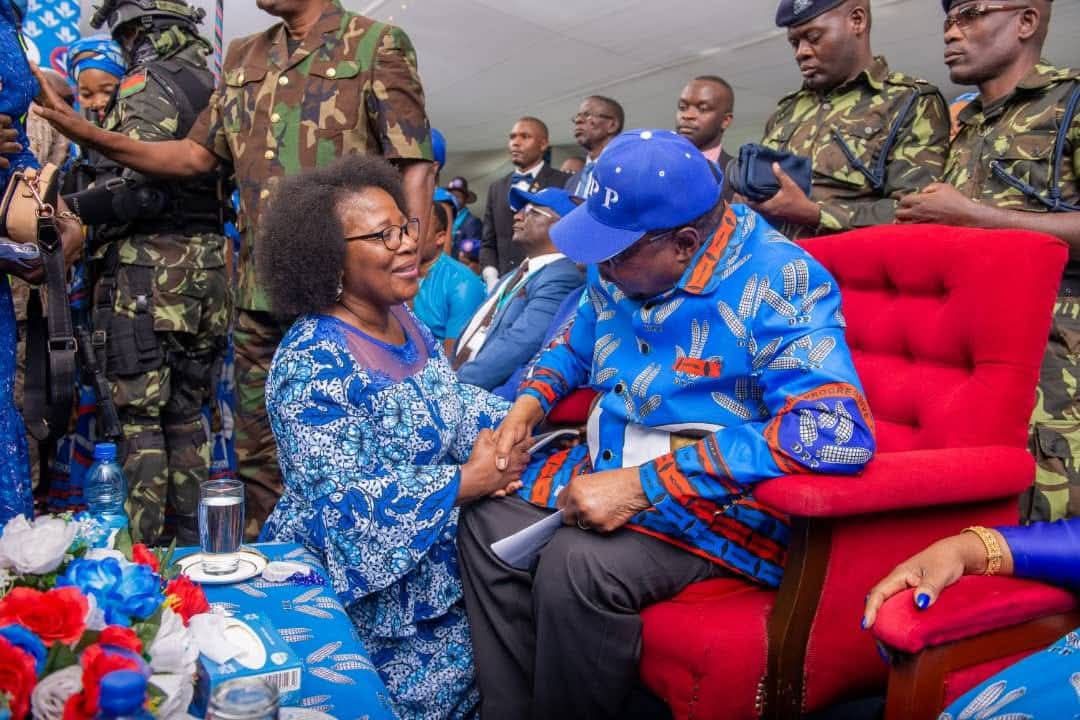
    Similarly, Esther Katumbu, a 35-year-old woman from Chomba Village in Mangochi, received flour and salt from Mangochi malombe constituency shadow Mp for Peoples Party  (PP) Ivy Faith Sande during the campaign period.

    “I didn’t know receiving such gifts is wrong,” she said. “This is the only time we benefit, because after elections they disappear.”

    In Kasungu, villagers like Loyce Manda received two bags of maize distributed by local leaders — an act seen as an attempt to influence votes ahead of the polls.

    “We thought this was Mtukula Pakhomo, which we were supposed to receive in January,” she said. “But to our surprise, we received the maize in September, just two weeks before elections.”

    In Blantyre’s Chemusa Township, tensions erupted when supporters returning from a PDP rally fought over unfulfilled cash promises.

    “The truck stopped to drop off supporters, but they were shocked not to receive the promised K5,000. That’s when the misunderstanding started,” an eyewitness said.

    Findings by Chisankho Watch, a coalition of civil society groups on elections observer team indicated that the official campaign period for the September 16 General Election was marred by intimidation, widespread violence vote-buying and creation of political ‘no-go zones.

    The report showed that there were targeted electoral malpractices and documented eight verified critical incidents and widespread systemic issues such as handouts and abuse of State resources across multiple districts.

    Chisankho Watch board chairperson Gilford Matonga told the Nation Newspaper in July that while the incidents were not uniform nationwide, they represent dangerous hotspots.

    On handouts, the report said 16 percent of observers recorded candidates or parties distributing money, food, or gifts at rallies. The practice was specifically noted in Lilongwe, Nkhata Bay, Blantyre, Salima, Mwanza and Balaka.

    Speaking at Mzoma in Mzimba district during a political debate for members of parliament in August this year, National Initiative for Civic education NICE public trust executive director Grey Kalindakafe also shared his concerns on handouts from politicians during the campaign period stating that it is against the electoral laws.

    However, Registrar of Political Parties, Kizito Tenthani, confirmed receiving numerous complaints related to campaign handouts.

    “We have received over 180 complaints related to handouts and other campaign violations. Investigations are underway, and some cases have already been resolved. We’ll share our findings with the country soon,” Tenthani said.

    Legal expert Dr. Bernadette Malunga expressed concern over the lack of enforcement, saying that failure to act will only encourage future violations.

    “What the registrar does now will set a precedent for future elections. There must be proper investigations and consequences,” she emphasized.

    Political and governance commentator Dr. George Chaima went further, warning that corruption has become normalized in Malawi’s politics.

    “The problem is we’re normalizing corruption. If the law were enforced, people would fear breaking it. We need leaders chosen for their vision, not their wallets,” Dr. Chaima said.

    The high cost of running political campaigns in Malawi — estimated at over K50 million for viable candidates — has created an uneven playing field. Only those with significant financial resources can compete effectively, leaving capable but poorer candidates sidelined. These dynamic risks transforming elections into auctions where wealth, not merit, determines leadership.

    In Mangochi South Constituency, DPP’s Ibrahim Mtukanika Rodrick has contested election results, alleging that the winning candidate, Bilal Mussa Tambuli, engaged in unlawful practices. This is just one of many cases now before the courts, as candidates seek justice over alleged electoral misconduct.

    Vote-buying is not unique to Malawi. Across Africa — in countries like Nigeria and Kenya — politicians frequently use handouts to manipulate voters. The pattern reflects a deeper problem: the commodification of democracy itself.

    Experts say Malawi must strengthen the enforcement of the Political Parties Act, prosecute offenders, and invest in civic education to empower voters to reject transactional politics. Until then, Malawi’s democracy remains vulnerable to manipulation — and its elections for sale to the highest bidder.


  • Scottish First Minister hails NBM Development Bank model

    Scottish First Minister hails NBM Development Bank model

    Scottish First Minister, John Swinney has commended the development bank model being championed by NBM Development Bank Limited to support the growth of Small and Medium Enterprises (SMEs) for greater impact in their respective societies in the country.

    Swinney made the remarks after meeting directors and officials from NBM Development Bank Ltd, and other SMEs in the country on Sunday in Blantyre, to appreciate their business ideas and progress.

    NBM Development Bank Ltd is a subsidiary of National Bank of Malawi (NBM) plc.

    It is a Development Finance Institution licensed by the Reserve Bank of Malawi (RBM), established as a long-term financing arm of NBM plc for small to medium sized enterprises (SMEs).

    “I support the development bank model because it provides an opportunity for SMEs to grow by accessing financial support which is not the same as loans from commercial banks. Scotland is committed to supporting Malawi in areas like health, education, and climate change mitigation through collaborative projects, including support for grassroots initiatives and rural development.”

    “Our government is committed to investing in projects that build capacity and attract further investment,” said Swinney.

    NBM plc Chief Operations Officer (COO) Masauko Katsala, who is also one of the NBM Development Bank Ltd Directors, commended the Scottish First Minister for granting them an audience, while pleading for more support to continue with their mission of empowering the local SMEs.

    “The Development Bank provides debt and equity capital to SMEs within key target sectors, and also assists these enterprises with business support services in order to assure viability of the enterprises. The Bank also assists these enterprises with business support services in order to assure viability of the enterprises.”

    “The distinguishing feature of our financing model against commercial bank’s lending is that all applications have to demonstrate a development impact in terms of promoting environmental and social economic sustainability like financing of clean energy products and financing of projects that create jobs,’’ said Katsala.

    Katsala said the Bank has already financed some women-led projects which are doing well, and that also demonstrates NBM plc’s commitment to empowering women in the country.

  • NBM fires up Scorchers ahead of AFCON qualifiers

    NBM fires up Scorchers ahead of AFCON qualifiers

    National Bank of Malawi (NBM) plc has reiterated its full support to the Malawi Women’s National Football Team, the Scorchers, as they leave the country for Angola to take part in the Africa Cup of Nations (AFCON) qualifiers on Thursday.

    Speaking after seeing off the team at Bakili Muluzi International Airport in Blantyre on Tuesday, NBM plc Marketing and Corporate Affairs Manager Akossa Hiwa, said the Bank, as the official sponsor, is proud to stand behind the Scorchers and remains optimistic about their performance.

    “We have all the faith in the Scorchers because they have shown that they are a force to reckon with on the pitch. They have given 100%, and as a sponsor, we are fully behind them,” said Hiwa.

    Hiwa added that NBM plc employees, known internally as ‘Blue Hearts’, are united in their support for the Scorchers, with a series of internal and external initiatives planned to rally the nation behind the team.

    “We are all rallying for them and will have a number of activities to show our support. This is not just about sponsorship; it’s about national pride and empowerment,” said Hiwa.

    She emphasized that NBM plc’s investment in women’s football reflects the Bank’s broader obligation to grassroots development and inclusivity in sports.

    “NBM plc was the first to sponsor a full tournament in the women’s league and the first to take up the Scorchers. We believe this provides a platform for the development of the sport and inspires young girls across Malawi to know that their dreams are valid.”

    “This is more than sponsorship. It is about building a legacy that shows young Malawian girls that they too can rise to the world stage,” said Hiwa.

    Hiwa urged the Scorchers to give their best performance at the tournament, saying the nation’s hopes and aspirations rest on their shoulders.

    Meanwhile, the team’s coach Lovemore Fazili expressed confidence in his squad’s readiness after weeks of intensive training.

    “We have touched every part of the game from goalkeeping to attack and I believe we are ready. I promise Malawians that when we go to Angola, we will bring good results,” said Fazili.

    The Scorchers are scheduled to play the decisive return fixture on October 28 at the Bingu National Stadium in Lilongwe.


  • Castel Malawi strengthens employee welfare, market leadership

    Castel Malawi strengthens employee welfare, market leadership

    Castel Malawi Limited has deepened its drive to foster employee well-being and strengthen workplace harmony, following the successful Castel Malawi Workers Union (Camawu) Annual General Meeting (AGM) held in Salima over the weekend.

    Addressing Camawu members, Castel Malawi Human Resources and Corporate Affairs Director, Gloria Zimba, stressed that the company values a strong, independent workers union as an essential partner in promoting a healthy and productive working environment.

    “We believe that an organization with an empowered union and employees who freely express themselves is better positioned to thrive. The annual general meeting provides a space for reflection, review, and planning, ensuring that employees and management continue moving forward together,’’ said Zimba.

    Zimba highlighted several milestones achieved since the last AGM, particularly in the area of employee welfare and work-life balance.

    Among the developments, Castel Malawi has established social welfare teams, including football and netball clubs in Blantyre, Lilongwe, and Mzuzu, to promote unity and well-being among staff.

    Recognizing the importance of inclusivity, Castel Malawi has improved facilities for casual employees, including new restrooms, changing areas, and designated break spaces, ensuring that all workers enjoy dignity and comfort regardless of employment status.

    “Casual workers deserve to be treated with the same respect as permanent employees. We are proud of the progress we have made in providing them with proper amenities and spaces,” said Zimba.

    From a business perspective, Castel Malawi continues to demonstrate strong market performance as it was recognized by the Malawi Revenue Authority (MRA), the second-highest taxpayer in Malawi last year.

    Zimba attributed the achievement to increased demand for Castel products, driven by the successful rebranding of Kuchekuche and the introduction of Sapitwa beer, both of which have injected new energy into the Castel brand.

    “These brands have captured the excitement of Malawian consumers, and we are proud to see that some of our products are now crossing borders into Mozambique and Zambia,” added Zimba.

    Camawu President, Ruben Kapito commended the collaborative spirit between management and employees.

    “Productivity has been high, and this shows that things are moving in the right direction. Castel Malawi is not only performing well in the market but also ensuring that employee concerns are heard,” said Kapito.


  • The Case of renewal: DPP at 20

    The Case of renewal: DPP at 20

    By Casper Jangale:

    When the Democratic Progressive Party (DPP) was born in 2005, it presented itself as a bold new force-pragmatic, developmental, and untainted by the corruption and infighting that plagued Malawi’s early multiparty years.

    Twenty years later, that promise has come full circle.

    The DPP has governed, stumbled, lost, and returned to power. Now, after its comeback in 2025, the party faces a decisive question: will it cling to old habits or embrace true renewal?

    The ideology that built the DPP From the start, the DPP’s strength lay not in rigid ideology but in practical ambition.

    Bingu wa Mutharika’s “Let the work of my hands speak for me” mantra captured the party’s essence: deliver roads, fertiliser, and growth and let results justify authority.

    This development-first posture resonated deeply with a nation weary of endless talk and little progress. Even today, many Malawians still associate the DPP with a period of relative economic stability and visible infrastructure expansion.

    The party’s identity as a developmentalist movement remains its greatest political asset. Yet, what once worked as a symbol of efficiency now risks becoming a relic of personality politics.

    The limits of a personality cult The DPP’s return to government under Arthur Peter Mutharika has revived familiar faces, networks, and slogans. But it has also reignited old tensions between reformers who see the need to modernise and loyalists who view renewal as betrayal.

    The reality is that Malawi’s political terrain has changed. A younger, more educated electorate no longer votes solely along regional or patronage lines. They demand transparency, accountability, and inclusive growth.

    The DPP cannot rely indefinitely on nostalgia for Bingu’s economic boom or Peter’s incumbency advantage. Renewal is not just desirable – it’s existential.

    Three fronts for renewal

    1. Leadership succession. The DPP must prepare a new generation of leaders who can translate its developmentalist legacy into 21st-century governance. Renewal does not mean erasing the Mutharika legacy it means extending it beyond one family. Grooming credible successors at parliamentary and district levels would signal confidence, not weakness.

    2. Institutional reform. The DPP’s biggest vulnerability has been its perception as a “winner- takes-all” organisation where power is centralised at the top. To rebuild credibility, it needs open internal elections, transparent financing, and consistent disciplinary procedures. A professional party secretariat not personality-based patronage should drive policy and organisation.

    3. Ideological clarity. The DPP’s greatest ideological strength-pragmatism has also been its weakness. Renewal requires articulating a clear, forward-looking vision: a progressive developmental state that invests in production, digitalisation, and youth employment while maintaining fiscal discipline.

    A written manifesto that ties spending priorities to measurable outcomes would turn slogans into strategy. Renewal as political insurance Renewal is not just about good governance it’s about survival. Across Africa, parties that failed to reinvent themselves after two decades in power have faded into opposition or irrelevance.

    The DPP’s 2020 defeat showed how quickly public goodwill evaporates when citizens sense arrogance or stagnation. Its 2025 victory gives it one more chance to prove that experience can coexist with humility and innovation.

    A test of legacy As the DPP marks its twentieth anniversary, it has a choice. It can remain a party of personalities, or it can become a movement of purpose one capable of leading Malawi through the next generation of economic and social transformation.

    True renewal will not come through speeches alone. It will come when younger leaders are empowered, when corruption is punished even within the party’s own ranks, and when the DPP’s. idea of “development” shifts from infrastructure to inclusion-jobs, education, and technology.

    If the DPP can rise to that challenge, it might not just survive the next election cycle it could finally deliver on the full promise that inspired its creation in 2005.

  • FCB, Umodzi Park partner to celebrate and empower women

    FCB, Umodzi Park partner to celebrate and empower women

    First Capital Bank (FCB) says is it committed to empowering women in Malawi by supporting initiatives that promote their health and business growth, which are key areas that significantly impact women’s lives and development.

    The Bank’s position was made clear during a High Tea Party event in Lilongwe on Wednesday, held in partnership with Umodzi Park to celebrate Mother’s Day, under the theme ‘Empowering Women in Business and Health’.

    Speaking during the event, FCB Corporate Communications Manager, Memory Mwathengere, said the Bank remains committed to supporting initiatives that uplift women in different spheres of life.

    “We were very delighted with this year’s theme. As a Bank, we take these issues seriously because women today face numerous challenges that require both financial and emotional support. Partnering with Umodzi Park allowed us to celebrate women while also promoting their growth and wellbeing,” said Mwathengere.

    One of the keynote speakers, a business coach and entrepreneur Chifundo Chiphanzi, encouraged women to focus on financial discipline and long-term sustainability in their businesses.

    “We are encouraging women to plan before spending money in their businesses. Proper planning and prioritisation not only sustain a business but also create room for growth and legacy building,” she said.

    On her part, Hlalapi Kunkeyani, a nurse at Kamuzu Central Hospital, highlighted the importance of women prioritising their health as a foundation for family and community wellbeing.

    “A healthy mother is a strong mother. When a woman takes care of her health, she is able to care for her family, her community, and contribute meaningfully to the development of the nation,” she said.

    The event served as both a celebration of motherhood and a platform for women from various sectors to discuss critical issues surrounding entrepreneurship and women’s health.