
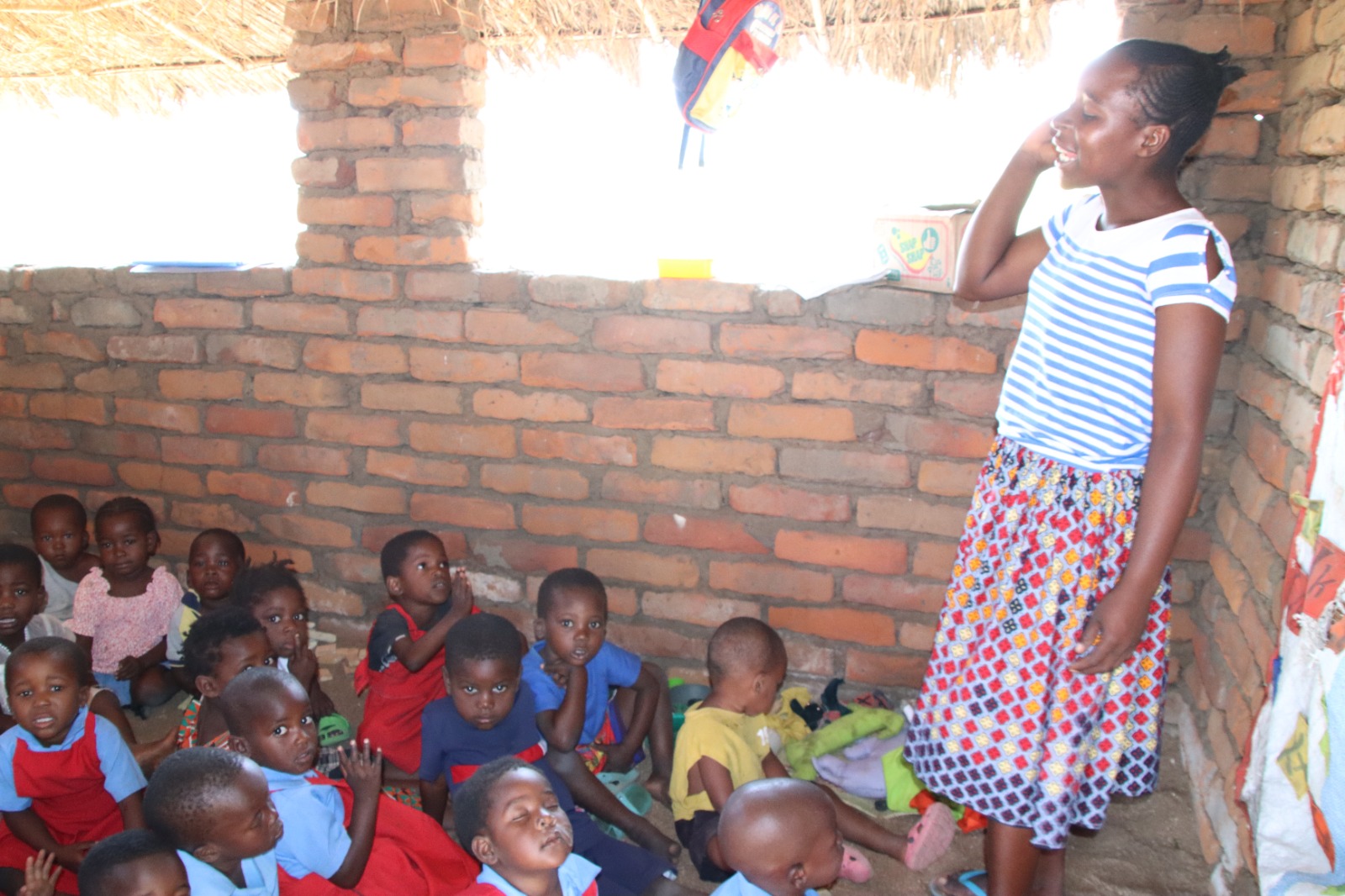
In Bisai Village, Sub-Traditional Authority Kapichi in Mangochi, children under the age of five used to roam around the village with no access to Early Childhood Development lessons.That worried Emily Peter.
At 26, married with two children, Emily realized that without a foundation in early childhood development , children in her village were starting primary school already behind.
“I saw children struggling. There was no place for them to learn, to play, to be prepared for school. I told myself the community needed someone to stand up,” says Emily.
That someone became her.
Driven by passion, Emily mobilized two other women and together they started Amazing Grace Community-Based Childcare Centre (CBCC). What began under a tree has now grown to over 40 children, all eager to learn.
It has not been easy. Emily and her fellow caregivers are volunteers. They receive no salary, yet they show up every day, sacrificing their time to shape the future of Bisai.
“We do it because we love the children. We want to develop our area,” she says.


The centre is now one of eight CBCCs being supported by the Malawi Red Cross Society (MRCS) through its four-year Community Resilience Project which started in 2023. The project focuses on agriculture, health and empowerment.
Through its empowerment component, MRCS has been supporting CBCCs in Mangochi with capacity building trainings, provision of food and porridge for the children, and trainings on how to make and use teaching and learning materials from locally available resources.
“The support from Malawi Red Cross has helped us a lot. We learned how to teach the children better, how to make toys and learning materials without money, and our children are now getting porridge at school,” Emily explains.
But challenges remain.
 The structure they use is in poor condition and becomes almost unusable during the rainy season. At first, households were contributing K500 each to support the CBCC, but the contributions stopped after MRCS came in.
“When Red Cross started supporting us, some community members thought we were being given money, so they stopped contributing. Now we struggle to maintain our daily needs. We are appealing for support to have a good structure where our children can learn safely.”
MRCS Community Development Officer responsible for Sub-TA Kapichi, David Zimba, says investing in CBCCs is investing in the future of education.
“Children who pass through CBCCs perform very well when they go to primary school. They are more confident, they know how to interact, and they grasp lessons faster,” says Zimba.
He however says MRCS currently has no budget for construction of CBCC structures.
“Our support is focused on capacity building and food support, but we are trying to link centres like Amazing Grace to other partners who can support them with infrastructure,” he says.
Despite the challenges, Emily remains hopeful.
Every morning, over 40 little faces gather at Amazing Grace, singing, counting and dreaming – because one woman decided not to wait for help, but to become the help her community needed.